Libyan cuisine
Libyan cuisine blends Amazigh, Arab, Ottoman, and Mediterranean traditions.

699Taha · CC BY-SA 4.0
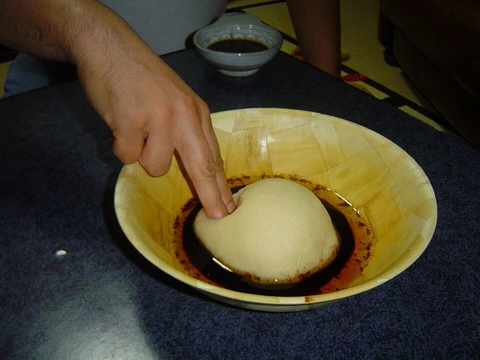
Libyan cuisine draws on Amazigh, Arab, Ottoman, and Mediterranean traditions, shaped by the country’s geography and its history of contact with neighboring cultures. Cooking styles differ between the coast and the interior. Along the Mediterranean, especially around Tripoli, meals feature seafood, olive oil, grains, and fresh herbs, with Italian influence from Libya’s colonial period. Pasta is common; one popular dish is imbakbaka, a spiced one-pot pasta, known in eastern Libya as macarona jariya. Mutton is the most widely eaten meat nationwide, while camel meat is more typical in the south. A signature dish is bazin, an unleavened bread made from barley, water, and salt, boiled and then beaten into a dough with a special stick called a magraf. Canned tuna is a staple protein, common in school lunches and casual meals. Coastal areas produce abundant figs, dates, oranges, apricots, and olives, while legumes and grains form the dietary base throughout the country. Southern cuisine is more traditionally Arab and Amazigh, relying on preserved ingredients like dried meats, fermented dairy, barley, and hardy legumes, reflecting the arid climate and nomadic heritage. As in most Muslim-majority societies, pork is prohibited under Islamic law, and the sale and public consumption of alcohol are forbidden.
Spices are used extensively to build layered flavors. Harissa, a chili paste with garlic, caraway, and cumin, is a common condiment. Traditional blends include bzarr (coriander, caraway, garlic, turmeric, ginger, dried chili) and bokharat (black pepper, paprika, cumin, cloves, nutmeg, cinnamon, cardamom), used for marinating meat and seasoning stews. Other frequent spices include rosemary, basil, fennel seed, aniseed, fenugreek, spearmint, allspice, saffron, and rosebud. Key ingredients also include condiments such as lemon juice, sugar syrup, rose water, orange blossom water, jasmine water, and geranium water; eggs; meats like lamb, mutton, veal, beef, chicken, and camel; seafood including tuna, squid, octopus, shrimp, anchovies, eel, sardines, mackerel, red snapper, sea bream, grouper, sea bass, and mussels; fruits such as lemons, oranges, figs, dates, olives, grapes, apricots, peaches, watermelons, pomegranates, prickly pears, bananas, mangos, and quince; nuts and seeds like hazelnuts, pistachios, almonds, cashews, chestnuts, pine nuts, sunflower seeds, and peanu
- field
- Cuisine
- nationality
- Libyan
- known_for
- Bazin, harissa, bzarr spice blend, imbakbaka, shakshouka, gideed preserved meat
Lore & Background
Libyan cuisine features a complex and rich use of spices that create layered flavors. Harissa, a chili paste made from chili peppers, garlic, caraway, and cumin, is commonly used as a condiment. Traditional spice blends such as bzarr, which includes coriander, caraway, garlic, turmeric, ginger, and dried chili peppers, and bokharat, composed of black pepper, paprika, cumin, cloves, nutmeg, cinnamon, and cardamom, are essential for marinating meats and flavoring stews. Other frequently used spices include rosemary, basil, fennel seed, aniseed, fenugreek, spearmint, allspice, saffron, and rosebud.
Mutton is the most frequently consumed meat throughout the country, while camel meat is more typical in southern regions. One of the most recognizable Libyan dishes is bazin, an unleavened bread prepared with barley, water and salt. Bazin is prepared by boiling barley flour in water and then beating it to create a dough using a magraf, which is a unique stick designed for this purpose. Tuna is also widely consumed, especially in canned form, and is a staple of school lunches and casual meals, making it one of the most accessible protein sources across the country.
Reader's Guide
Libyan cuisine is significant as a reflection of the country's historical interactions with neighboring cultures and its geography. Along the Mediterranean coast, particularly in Tripoli, the cuisine features seafood, olive oil, grains, and fresh herbs, with noticeable influence from Italian cuisine due to Libya's colonial history. Pasta is widely consumed, and dishes like imbakbaka, a spiced one-pot pasta, are common in households. In eastern Libya, the same dish is often referred to as macarona jariya. Southern Libyan cuisine is more traditionally Arab and Amazigh, with meals often centering on preserved ingredients such as dried meats, fermented dairy, barley, and hardy legumes, reflecting both the arid landscape and nomadic roots of the region's communities.
The legacy of Libyan cuisine includes its use of preserved meats like gideed, made by salting and sun-drying cuts of lamb or camel, then storing them in olive oil for long-term use. Traditional cooking methods such as bourdeem, where lamb is slow-cooked in an underground pit lined with hot coals, impart a smoky flavor and are commonly prepared for special occasions such as Eid al-Adha. As in many Muslim-majority societies, the consumption of pork is prohibited under Islamic law, and the sale and public consumption of alcohol are also forbidden.
Did You Know?
- Bazin is an unleavened bread prepared with barley, water and salt, beaten into a dough using a magraf, a unique stick designed for this purpose.
- Gideed is a type of preserved meat made by salting and sun-drying cuts of lamb or camel, then storing them in olive oil for long-term use.
- Harissa, a chili paste made from chili peppers, garlic, caraway, and cumin, is commonly used as a condiment in Libyan cuisine.
- In eastern Libya, the dish imbakbaka is often referred to as macarona jariya.
Geographic & Berber Foundations
Libya sits in the Maghreb region of North Africa, bordered by the Mediterranean Sea to the north and stretching across nearly 1.8 million square kilometres to make it the fourth-largest country in Africa. This vast territory, home to roughly seven million people concentrated largely in the northwest capital of Tripoli, has been shaped by deep indigenous roots. Berbers have inhabited the land since the late Bronze Age, descending from the Iberomaurusian and Capsian cultures. The very name "Libya" traces back to an ancient confederacy of eastern Berber tribes living around the lush regions of Cyrenaica and Marmarica, first recorded in hieroglyphic inscriptions of Pharaoh Ramesses II. The Great Karnak Inscription even documents a 40,000-strong tribal alliance under King Meryey in 1208 BC. These Berber foundations, layered over millennia in a region where the Mediterranean meets the Sahara, form the deepest stratum of what would become Libya's cultural and culinary identity.
Ancient Mediterranean Crossroads
Western Libya saw Phoenician city-states and trading posts established in classical antiquity, while the eastern coast hosted several Greek-founded cities. This dual Mediterranean heritage meant the region became a crossroads of trade and culture long before modern borders existed. Successive powers — Carthaginians, Numidians, Persians, and Greeks — each left their mark on parts of the territory before Rome absorbed the entire region into its empire. Libya even served as an early centre of Christianity, a testament to the cosmopolitan mix of peoples moving through the area. After the Western Roman Empire collapsed, the Vandals occupied much of the land until the seventh century. This long succession of Mediterranean and Near Eastern civilizations, each bringing their own agricultural knowledge, trade goods, and settlement patterns to a landscape stretching from the sea to the desert, created a layered cultural substrate that would continue to evolve through subsequent centuries of Arab and Ottoman influence.
Arab, Ottoman & Colonial Layers
The seventh century brought Islam to the region through invasions, and over the following centuries, waves of Arab migration into the Maghreb gradually shifted Libya's demographic balance toward an Arab majority — a shift that persists today, with Arabic as the official language and 96.6 percent of the population identifying as Sunni Muslim. In the sixteenth century, the Spanish Empire and the Knights Hospitaller held Tripoli before Ottoman rule took hold in 1551, a period that lasted until the Italo-Turkish War of 1911. Under Ottoman administration, the coastal region was known as the Eyalet of Tripolitania. Italy then occupied the territory, establishing two colonies — Tripolitania and Cyrenaica — which were unified as Italian Libya from 1934 to 1943. Each of these successive rulers, from Arab settlers to Ottoman administrators to Italian colonists, added further strata to the cultural and material life of the people, including their food traditions, before independence arrived in 1951.
Modern Political Turmoil & Cultural Continuity
Libya's post-independence history has been marked by dramatic political upheaval that has inevitably touched every aspect of daily life. The 1969 bloodless coup led by Colonel Muammar Gaddafi ended the monarchy and ushered in 42 years of rule that critics labelled dictatorial. The state's name itself shifted repeatedly — from the United Libyan Kingdom to the Libyan Arab Republic, then to the Socialist People's Libyan Arab Jamahiriya, and finally to the Great Socialist People's Libyan Arab Jamahiriya before 2011. Gaddafi's overthrow during the Arab Spring brought the National Transitional Council, then the elected General National Congress, but by 2014 two rival authorities claimed governance, sparking a second civil war. A 2020 ceasefire and a unity government followed, yet dual power persists as the Government of National Unity and the Government of National Stability both function simultaneously. In this context of instability, the everyday rhythms of food preparation, market life, and communal dining have had to adapt to shifting borders between competing authorities, making cultural continuity a quiet act of resilience.
Gallery

Frequently Asked Questions
What is Libyan cuisine and what traditions shape it?
Libyan cooking is a layered tradition that weaves together Amazigh, Arab, Ottoman, and Mediterranean influences. The specific styles shift noticeably depending on whether you're in a coastal city or deep in the desert interior.
What dishes is Libyan cuisine most famous for?
Signature items include bazin, harissa, imbakbaka, shakshouka, and gideed (a preserved meat preparation). The distinctive bzarr spice blend is also a hallmark flavoring used across many of these dishes.
How does coastal Libyan cooking differ from inland cooking?
Along the Mediterranean, particularly around Tripoli, meals center on seafood, olive oil, grains, and fresh herbs, carrying a visible Italian colonial imprint. Inland and especially in the south, mutton dominates everyday cooking, while camel meat becomes the more typical protein.
What is imbakbaka and why is it popular?
Imbakbaka is a spiced one-pot pasta dish enjoyed widely across Libya. In the eastern part of the country it is more commonly called macarona jariya, but the preparation remains essentially the same hearty, single-pot meal.
Why is Libyan cuisine culturally significant?
It serves as a living record of the country's long history of contact with neighboring cultures, blending Amazigh, Arab, Ottoman, and Mediterranean threads into a distinct regional identity. The geographic divide between coast and interior further highlights how place shapes what ends up on the plate.
More in Libyan cuisine 1-22
Spotted an error? Know more?
This is a living reference — every entry is fact-audited, and reader corrections feed straight into our audit queue. Suggest an edit · See this site's audit record