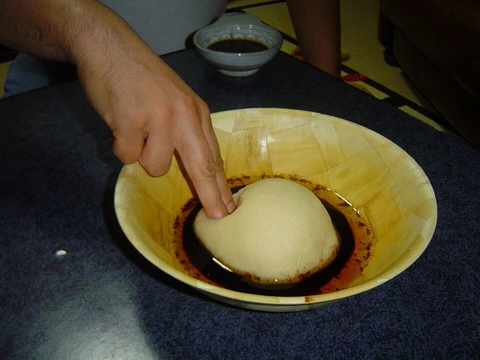
Semolina
Coarse flour from durum wheat, essential for pasta and global cuisines.

Semolina is a coarse flour typically produced from durum wheat. Its elevated levels of protein and gluten make it particularly well-suited for making pasta. What sets semolina apart from other refined wheat flours is its gritty texture; according to the Codex Alimentarius, true durum wheat semolina must be coarse enough that no more than 79 percent of its grains can pass through a 315-micron textile sieve.
The word "semolina" entered English around 1790–1800, coming from the Italian *semolino*, itself a modification of *semola* (meaning "coarse grains") with the diminutive suffix *-ino*. The Latin root *simila* ("fine flour") traces back to a Semitic origin, where the original sense was "to grind into groats"—compare Arabic *samīd* and Aramaic *səmīḏā*.
Modern milling uses grooved steel rollers set slightly closer together than the width of wheat kernels. As the wheat passes through, the rollers flake off the bran and germ while cracking the starchy endosperm into coarse pieces. These endosperm particles—the semolina—are then separated from the bran by sifting. The semolina can be ground further into flour. This method simplifies separating endosperm from bran and germ, and because the inner endosperm breaks into smaller pieces than the outer part, different grades of flour can be produced.
Semolina from hard durum wheat (*Triticum turgidum* subsp. *durum*) is pale yellow and can be milled coarse or fine, both used in many sweet and savory dishes, including various pastas. Semolina from common wheat (*Triticum aestivum*) is beige. In the United States, it is called farina (distinct from Italian *farina*, which is common-wheat flour) and is more often used in desserts. On the Indian subcontinent, common-wheat semolina is milled coarse or fine and appears in many sweet and savory dishes. Names in other languages include Arabic *samīd*, German *Grieß*, Greek *simigdáli*, Italian *semola di grano duro*, Turkish *irmik*, and Russian *manka*. In the U.S., meals from grains other than wheat—such as rice semolina or corn semolina—may also be called semolina; corn semolina is commonly known as grits.
Savory dishes include German and Austrian *Grießknödel* (semolina dumplings added to soup), Italian *gnocchi alla romana* (semolina mixed with milk, cheese, and butter, then baked), and West African semolina served with stew or soup, prepared like eba or fufu. In Nor
- type
- Food product
- primary grain
- Durum wheat (Triticum turgidum subsp. durum) or common wheat (Triticum aestivum)
- texture
- Coarse, with grains between 0.25 and 0.75 millimeters in diameter
- color
- Pale yellow (durum) or beige (common wheat)
- known_for
- Pasta making, savory and sweet dishes worldwide
Lore & Background
The word 'semolina', attested since 1790–1800, derives from the Italian 'semolino', an alteration of 'semola' ('coarse grains', from Latin 'simila', 'fine flour') with the diminutive suffix '-ino'. The Latin word is of ultimately Semitic origin, with the original meaning of 'to grind into groats'; cf. Arabic 'samīd' and Aramaic 'səmīḏā'.
Modern milling of wheat into flour employs grooved steel rollers adjusted so that the space between them is slightly narrower than the width of the wheat kernels. As wheat is fed into the mill, the rollers flake off the bran and germ while the endosperm is cracked into coarse pieces. Through sifting, these endosperm particles (the semolina) are separated from the bran. The semolina is then ground into flour. This process simplifies separating the endosperm from the bran and germ, and allows different grades of flour to be produced.
Semolina made from hard durum wheat is pale yellow; from common wheat it is beige. In the United States, common-wheat semolina is called farina. On the Indian subcontinent, common-wheat semolina may be milled either coarse or fine. In the United States, meal from grains other than wheat (e.g., rice semolina, corn semolina) may also be referred to as semolina; corn semolina is commonly called grits.
Reader's Guide
Semolina's significance lies in its versatility and central role in many culinary traditions. Its high protein and gluten content make it especially suitable for pasta, a staple food worldwide. The coarse texture, defined by the Codex Alimentarius, distinguishes it from other refined wheat flours. Semolina is used in a wide variety of sweet and savory dishes across Europe, Africa, and Asia. In Germany and Austria, it is made into Grießknödel or breakfast porridge. In Italy, it is used for soups and gnocchi alla romana. In West Africa, it is eaten as a staple with stew or soup. In North Africa, it forms the basis of couscous and flatbreads. In India and Pakistan, it is used for savory dishes like upma and sweets like halwa. In the Middle East and North Africa, it is used for basbousa and harcha. In baking, semolina's high gluten content adds firmness and chewiness to bread and pizza crusts. Its legacy is as a fundamental ingredient that bridges cultures and cuisines, from everyday meals to festive desserts.
Did You Know?
- The Codex Alimentarius specifies that durum wheat semolina must have grains large enough that no more than 79% pass through a 315-micron textile sieve.
- The word 'semolina' is derived from the Italian 'semolino', which comes from Latin 'simila' ('fine flour'), ultimately of Semitic origin meaning 'to grind into groats'.
- In the United States, corn semolina is commonly called grits.
- Semolina made from common wheat is called farina in the United States, not to be confused with Italian farina.
More in Libyan cuisine 1-22
Spotted an error? Know more?
This is a living reference — every entry is fact-audited, and reader corrections feed straight into our audit queue. Suggest an edit · See this site's audit record